 US Dollars

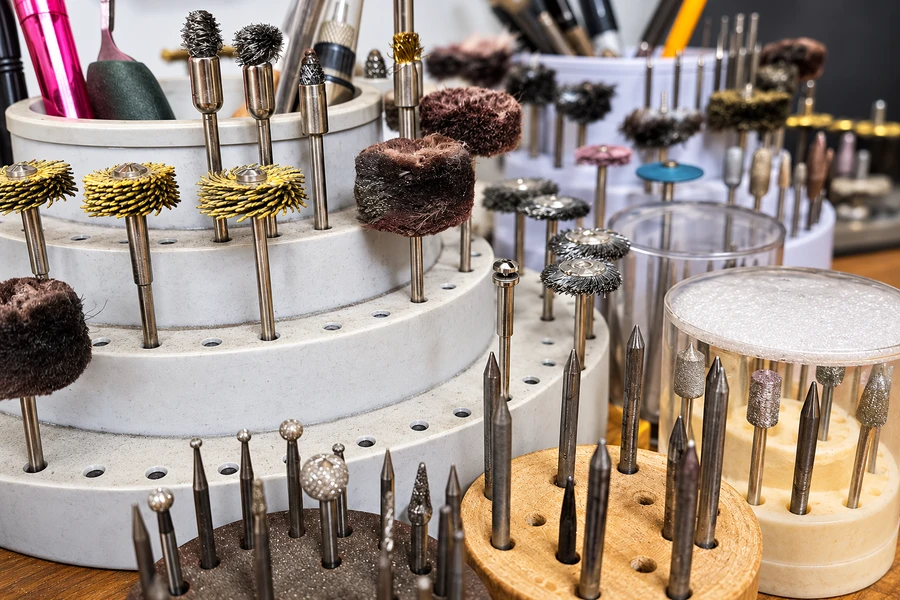
There's a particular atmosphere to a working silversmith's bench. The mechanical whirrings and buzzings of the flex shaft with its suite of rotary tools for grinding, drilling, and polishing. The rhythmic grating of a file tearing up metal as it is pushed along a surface. The strange choking sound of hot metal being quenched. It's a sensorium of small sounds and smells that, once encountered, is immediately recognizable as the place where jewelry is actually made.
Every tool at the bench has a reason for being there. Here's what they are — and what they do.
The Bench Pin and Jeweler's Saw
The bench pin — a simple wedge of hardwood mounted at the edge of the jeweler's bench — is deceptively essential. It is used for sawing, forming, shaping, drilling, and many other tasks, and is considered an absolute must-have for any working metalsmith. The V-shaped cutout in its tip provides a support and guide surface that makes precision work possible.
Working alongside it is the jeweler's saw — a fine, C-shaped frame strung with a blade so delicate it can cut intricate curves through sheet silver with extraordinary precision. The silversmith tests the blade's tension by plucking it like a guitar string: the right pitch — a strong, ringing twang — tells her the blade is correctly set. Too high and it will snap; too loose and it will bend rather than cut. A proper jeweler's saw is one of the most intimate tools at the bench — held, tensioned, and guided entirely by hand.
Hammers, Mandrels & Stakes
Shaping silver requires more than cutting it. Silversmiths use hammers to form metal over anvils and stakes — silver is hammered cold, at room temperature, and as the metal is worked it 'work-hardens,' becoming stiffer with each pass until it must be annealed (gently heated and allowed to cool) to restore its malleability.
Mandrels are tapered steel forms around which silver is shaped. A ring mandrel gives a band its perfect circular form; a bracelet mandrel does the same for cuffs. Mandrels come in various shapes and sizes and are used for shaping metal rings and other jewelry items.
Stakes serve a similar purpose for hollow and curved forms — made in different shapes to accommodate a variety of designs, they are held in place while the silversmith shapes metal around them.
The anvil provides the stable working surface that makes all of this possible. The anvil is arguably one of the most important pieces of equipment in any metalworker's workshop — providing a strong, stable surface on which to work and manipulate metals without fear of breakage.
Files, Emery Paper & Sanding
Once a piece is shaped and soldered, the surface work begins. Files come in a remarkable variety — flat, half-round, triangular, barrette — each suited to a different contour and task. Needle files handle tight interior spaces; larger files remove excess solder and smooth seams. After filing comes emery paper in progressively finer grits, working the surface toward smoothness before polishing begins.
The Pickle Pot
After any heat work — soldering, annealing — the piece goes into “pickle”. Pickle solution removes the oxidation and flux residues that form during soldering, leaving the silver clean and ready for the next stage of finishing. The pickle pot is typically a small slow cooker or dedicated vessel that keeps the acid solution warm — warm acid works faster and more thoroughly than cold.
Pieces are moved in and out of pickle using copper or plastic tongs — never steel, which reacts with the acid and can contaminate the solution, causing copper flash to deposit on the silver. After pickling, the piece is rinsed, neutralized in a baking soda solution, and rinsed again before any further work.
The Flex Shaft
The flex shaft is a flexible rotary tool — essentially a motorized handpiece on a long, flexible cable — used for grinding, polishing, and drilling. It accepts a vast range of attachments: abrasive wheels, rubber polishing points, drill bits, engraving burrs, and bristle brushes. The flex shaft is the closest thing at the jeweler's bench to a universal tool — capable of working in tight spaces and on complex surfaces that a bench polisher cannot reach.
Rouge and the Polishing Wheel
The final stage of finishing — after filing, sanding, and any patina or enamel work — is polishing. This typically happens in two stages.
Tripoli is an abrasive compound used first to remove fine scratches and surface marks, bringing the silver to a pre-polish stage. It cuts relatively aggressively and prepares the surface for the final step.
Red rouge (jeweler's rouge) is the traditional final polish compound — finer and less abrasive, it brings sterling silver to its characteristic bright, mirror-like shine. Rouge is applied to a buffing wheel or polishing cloth and worked across the surface with consistent, controlled pressure. The result, when done well, is immediate and unmistakable.
Burnishers — smooth, hardened steel tools in various shapes — are used to compress and smooth specific surfaces, particularly around stone settings and bezels, where a polishing wheel cannot reach. The burnisher is used to smooth bezel edges and refine details that require hand pressure rather than abrasion.
The Loupe
At every stage of the process, the silversmith examines their work under magnification. A jeweler's loupe — typically 10x magnification — reveals what the naked eye misses: solder joints that haven't fully flowed, file marks that remain, surface scratches that need further attention. At the scale of fine jewelry, a millimeter of difference changes everything. The loupe is the tool that makes sure nothing is missed.
The Maker's Mark
The last thing applied to every finished Breakell piece is the smallest: our maker's mark, stamped by hand into the metal. It's a simple act — and a significant one. It says that this piece passed through all of these tools, all of these stages, all of these hands, and emerged as something worth putting our name on.
That mark is what the whole bench is working toward.
Visit our workshop and showroom at 215 Goddard Row in Newport's historic Brick Market, or explore our full handcrafted collection at breakell.com.
