 US Dollars

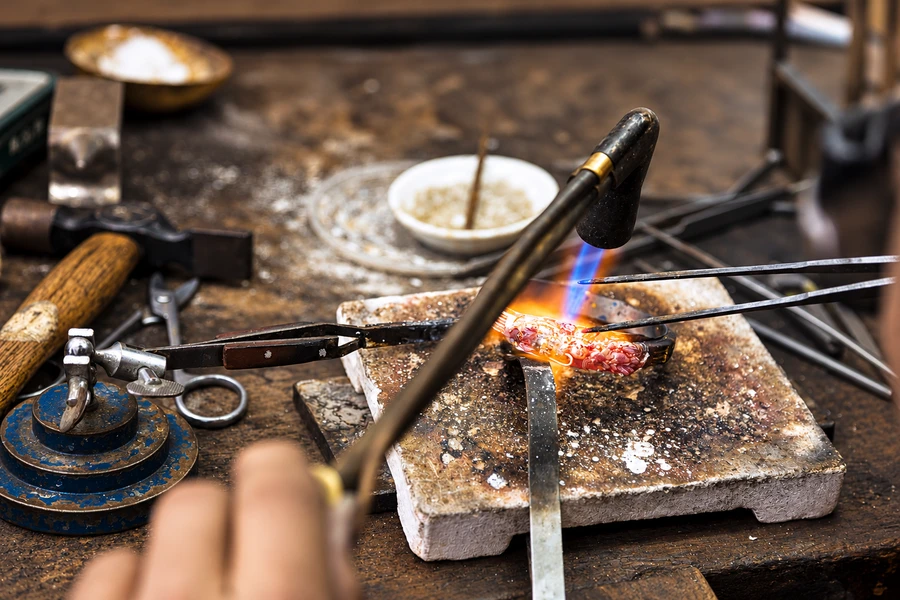
There is a moment at the jeweler's bench — torch in hand, piece glowing faintly on the soldering block — when everything the silversmith knows converges into a single decision: now. Pull back a fraction of a second too soon and the solder won't flow. Stay a breath too long and a piece that took hours to build melts in an instant.
The torch is the most powerful tool in the silversmith's workshop. Understanding it — and the solder that works alongside it — is what separates a confident craftsperson from one who is always guessing.
Choosing Your Torch
Not all torches are created equal, and the right choice depends on the scale and complexity of the work.
Butane torches are the most accessible entry point. Butane canister jewelry torches are an inexpensive and easy way to bring a heat source into the jewelry studio, and are perfectly adequate for many annealing, soldering, and enameling projects. They're portable, straightforward to use, and suitable for small-scale work and repairs. Their limitation is heat output — for larger pieces or complex multi-joint work, a butane torch may not be able to sustain the temperature needed.
Propane torches offer more power and versatility. Compatible with refillable propane tanks, they are more fuel-efficient than disposable butane canisters and offer good flame control for soldering, annealing, and other jewelry techniques. Propane does require careful storage and ventilation, but for a working silversmith's studio it's a practical and capable upgrade.
The Smith Little Torch is the professional benchmark for precision work. Known for its exceptional flame control and high heat output, it is most commonly used with propane or acetylene paired with oxygen, and provides the precision ideal for intricate designs and fine soldering. Its flame can reach up to 6,000°F — hot enough to melt up to 3 oz of silver — and it comes with five interchangeable tips that regulate flame size and heat, from small tips for delicate work to larger tips for heavier pieces.
Oxygen-acetylene rigs represent the highest tier of heat output and adjustability. These torches use pressurized gas and pressurized oxygen with separate regulators and individual knobs at the torch head for adjusting gas and oxygen independently — the most complicated setup, the most hazardous, and the most costly, but also the most adjustable in terms of flame size and heat. For most silversmiths working in sterling silver, they are more than necessary — but for goldsmiths and those working with platinum, they are essential.
Understanding Flame
The flame itself is not uniform — and knowing its anatomy is as important as choosing the right torch. A well-adjusted flame has three zones: an inner cone of unburned gas, a middle zone of active combustion, and an outer envelope. Finding the 'sweet spot' of the flame — the zone of maximum, controlled heat — is one of the most important skills a silversmith develops.
A reducing flame (slightly fuel-rich) is generally preferred for silver soldering, as it limits oxidation of the metal surface. An oxidizing flame (excess oxygen) burns hotter but promotes the very oxidation silversmiths work to prevent. Learning to read the color and behavior of the flame — and to adjust it with the torch's valves — is something that comes only with practice.
The Four Grades of Solder
Silver solder comes in four grades, each defined by its melting point and silver content. Understanding which to use — and when — is fundamental to any multi-joint piece.
Hard solder — melting point approximately 1,425°F — is used for bezels and as the first step in pieces that require multiple soldering operations. Its higher silver content means the best color match to sterling silver.
Medium solder — melting point approximately 1,390°F — is used when only one or two solder joints are needed, or as the second step in a multi-joint piece.
Easy solder — melting point approximately 1,325°F — is used as a final solder step, or when soldering on findings such as clasps and jump rings.
Extra Easy solder — melting point approximately 1,270°F — is used primarily for repairs, particularly on pieces that have already been soldered and where higher heat could reflow existing joints.
The rule of thumb for multi-joint work: begin with the highest temperature solder first, then work down the grades. This ensures that each subsequent soldering step doesn't disturb the joints that preceded it. A piece with three joints might use hard, then medium, then easy — each step safely below the flow point of the last.
Flux: The Essential Partner
Solder does not flow cleanly on its own. Flux is applied directly to the pieces being joined and promotes fusion between the metal by removing oxidation from the surfaces, allowing the solder to flow more easily and improving the overall strength of the joint. Without flux, heat causes the silver to oxidize faster than the solder can bond — and the joint fails.
Flux comes in liquid and paste forms. For most silversmithing applications, a borax-based paste flux is the standard choice. Some smiths use a boric acid and alcohol mixture pre-applied to the entire piece before heating as a barrier against firescale — a technique that protects the broader surface while the joint-specific flux does its work at the seam.
Reading the Metal
Experienced silversmiths develop a relationship with heat that goes beyond technique. Professional silver work requires temperatures between 1,100°F and 1,650°F depending on solder type — and the best torch work comes from micro-adjustable flame control that allows you to hit those exact temperatures without scorching delicate components.
But thermometers aren't used at the bench. Instead, the silversmith reads the metal directly: the way the flux bubbles and flows, the dull red glow that appears in dim light just before solder temperature, the shimmer that moves across the surface just before the solder flows. These are the signals that tell an experienced smith when to act — and when to hold.
That knowledge lives in the hands and eyes, not in any manual. It accumulates over years of work at the bench. And it is, ultimately, what it means to be a silversmith.
Explore our handcrafted sterling silver and 14k gold jewelry at breakell.com, or visit us in Newport at 215 Goddard Row.
