 US Dollars

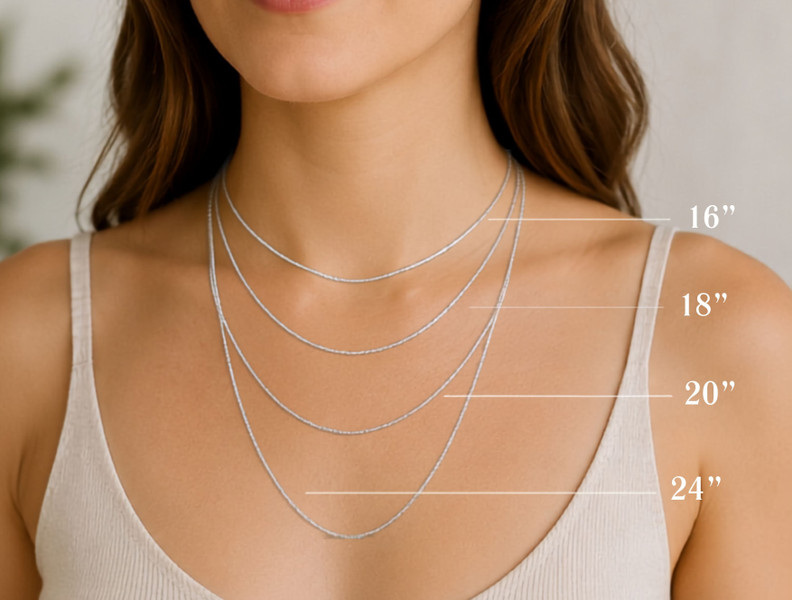
A chain is more than a practical detail — it's half the look. Whether you're building around a favorite pendant or searching for something to wear on its own, the right chain makes all the difference. Here's how we think about it.
Chain Style: Finding Your Match
- Cable & Oval Link Chains are the classic choice. Clean, versatile, and strong enough to hold most pendants — they work in sterling silver or 14k gold and never go out of style.
- Box Chains have a more structured, architectural feel. Their square links catch the light beautifully and pair well with geometric or modern pendants.
- Wheat Chains are twisted and luminous, adding texture and movement. They're particularly striking in 14k gold and work beautifully as a solo piece.
Chain Length: A Simple Guide
- 16 inches — Sits above or at the collarbone. Elegant for pendants you want close to the neckline.
- 18 inches — The most versatile length. Falls just below the collarbone and flatters nearly every neckline.
- 20–24 inches — Rests on the chest. Ideal for layering or wearing with open necklines.
Layering necklaces looks effortless when it's done well — which is exactly why it takes a little thought. The good news: there are just a few principles behind every great layered look, and once you understand them, the rest is pure instinct.
Rule One: Vary the Lengths
This is the foundation of layering. If two chains sit at the same length, they'll tangle and compete. If they're staggered — even by just an inch or two — they each carve out their own space and the effect is immediate.
A classic starting point: a 16-inch chain close to the collarbone, an 18-inch chain in the middle, and a 20-to-24-inch chain falling onto the chest. Each layer is visible, each pendant has room to breathe.
Rule Two: Mix Weights, Not Chaos
The most polished layered looks have variety — but not randomness. Mixing a fine cable chain with a slightly heavier rope or box chain adds visual texture without feeling cluttered. What you want to avoid is chains of identical weight and style stacked together; that reads as accidental rather than intentional.
A simple guideline: let the most delicate chain sit highest, and let the weight build as you go down.
Rule Three: Let One Piece Lead
In a layered look, one piece should be the focal point — the pendant with the most presence, the most meaning, or the most detail. The other layers support it.
Rule Four: Connect Through Metal
You don't have to match metals perfectly — mixing silver and gold is genuinely beautiful and has been a legitimate style choice for years. But there should be some connective thread: if you're mixing metals, let one dominate and the other accent. A primarily sterling silver stack with one 14k gold chain reads as intentional. An equal split can feel indecisive.
Breakell Pieces That Layer Beautifully
- Pendant chains in 16, 18, and 20-inch lengths create the length variation you need without having to find separate pieces.
- Celestial and sea life pendants — a north star, a tiny anchor— sit quietly in a layered stack without overwhelming.
- Birthstone pendants add a personal, colorful note at any length.
- Charm holder pendants let you cluster multiple charms into one layer, adding interest without adding chains.
A Final Word on Tangling
The number one frustration with layered necklaces is tangling. A few practical fixes: look for chains with different link styles (a cable chain and a rope chain are less likely to tangle than two cable chains), choose lengths with enough separation between them, and consider a layering clasp — a small finding that holds multiple chains at a single point at the back of the neck, keeping everything in place throughout the day.
